For the first couple of years of the PlayStation’s life in PAL territories, there were no holograms on game cases at all. That changed in early Q2 1997 when we start to see the hologram appear, introduced alongside the now-familiar black label strip along the bottom of the case front.
The hologram was almost certainly a reaction to the rise of mod chips. The original mod chip was created in Hong Kong in early 1996 by a western engineer working for a Hong Kong-based company, though it wasn’t until the autumn of that year that they really took off across Europe as prices dropped and reverse-engineered clones hit the market. Sony clearly needed a way to differentiate official retail products from bootleg copies, and the hologram was part of that response.
The Transition Period
The introduction of the hologram didn’t happen overnight, it rolled out over the course of a few months, with first-party games being the earliest to require them.
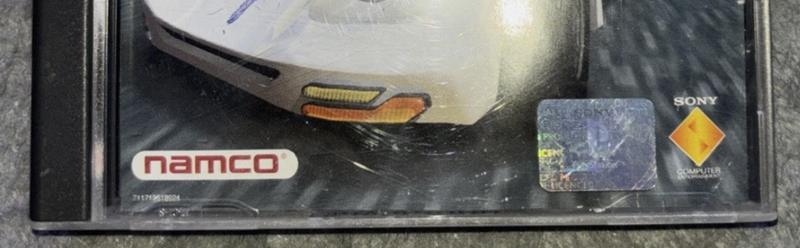
We can see this transition in titles like Ridge Racer Revolution, and Namco Museum Vol.4 and Vol.5, where the hologram requirement came at a point when the cover artwork had likely already been printed.
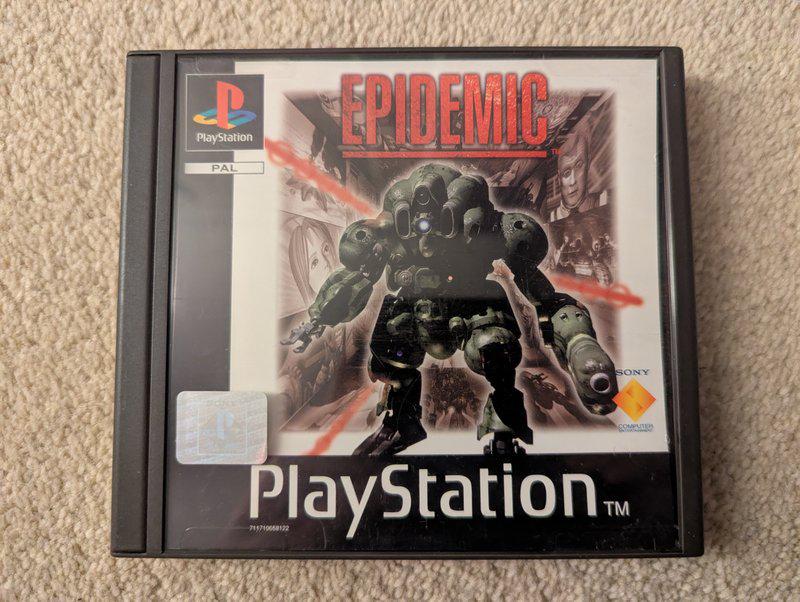
Epidemic was seemingly the first case to feature the new black label strip, but the design used the manual-style layout with a centralised “PlayStation” text logo. This left no room for the hologram in its usual position, so it was placed to the left but above the black label portion.
Based on the information I’ve compiled so far, you can see the evolution of hologram use in the graph below.
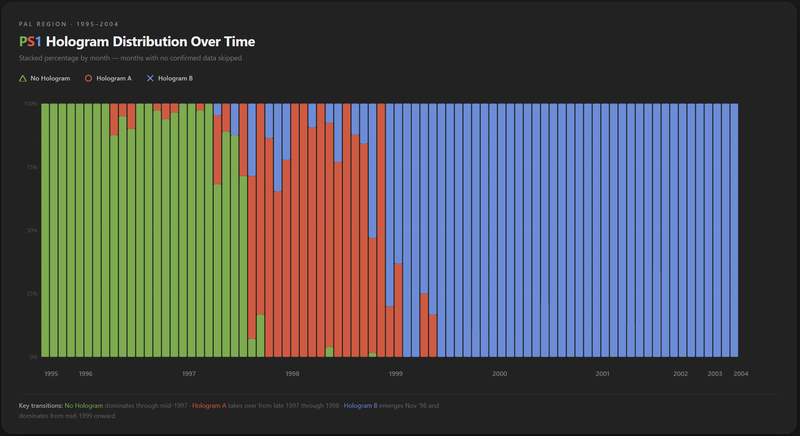
Over the course of late 1998 and early 1999, a second version of the hologram was phased in. This design was then used for the remainder of the PS1 era.
The First Hologram
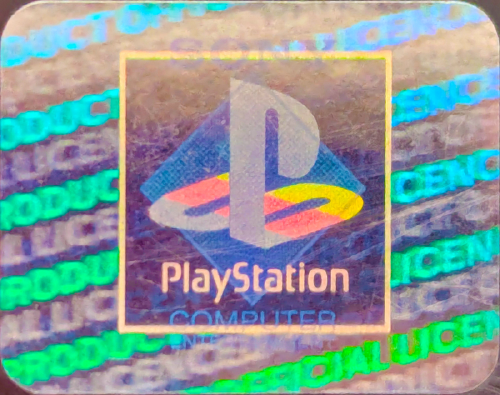
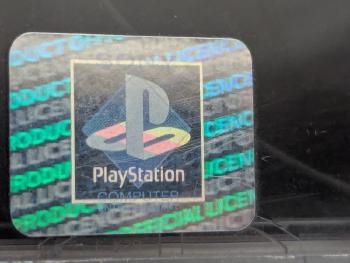
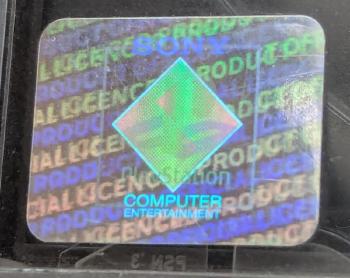
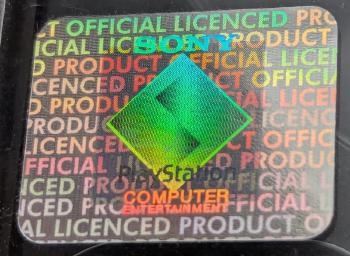
The first hologram featured the Sony Computer Entertainment logo mixed with the PlayStation logo, which would shift depending on the viewing angle.
The background was filled with the text “Official Licensed Product” running at a diagonal angle across the hologram.
The Second Hologram
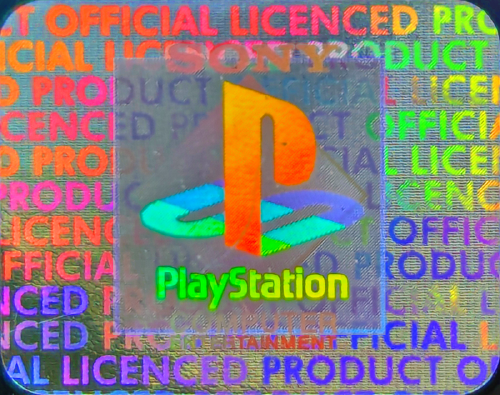
The second hologram is similar in that it retained the dual SCE and PlayStation logos. The key difference is in the background, the “Official Licensed Product” text was changed from the diagonal layout to a horizontal arrangement across twelve rows.
Hologram Misprints
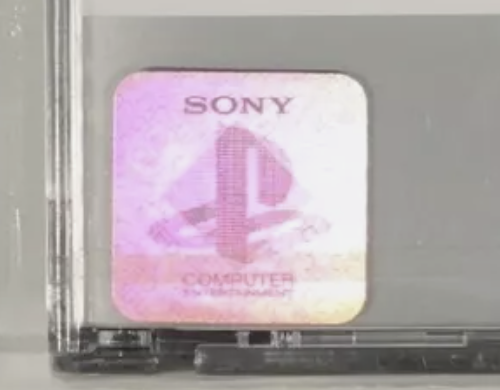
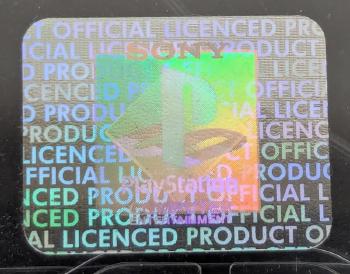
There are a handful of games released later in the PS1’s lifetime that were shipped with the wrong hologram entirely. Some copies of Final Fantasy VIII and Final Fantasy IX came with the square PSP version of the “Official Licensed Product” hologram, a design that wouldn’t have existed yet during the PS1 era’s peak.
This is almost certainly a mistake during case production rather than anything deliberate. The number of copies floating around with this error is very small, making them a curious oddity for collectors.
You can read more about this here.
Counterfeit Holograms
Unfortunately, as with anything collectible, counterfeits have started to appear. Reproduction holograms have been spotted in the PAL market, and while they look convincing at first glance, there are telltale signs that give them away.
The key things to watch for are diagonal feathering across the hologram surface, the inability to isolate the SCE logo at any angle, and a missing twelfth row in the “Official Licensed Product” background text.
I’ve written a detailed breakdown on how to spot these fakes, you can find that over on the Fake Holograms post.