Rental copies are one of the more confusing corners of PAL PS1 collecting. Some are easy to spot, some really aren’t, and a few look almost identical to promo and demo discs from the same period.
This is a guide to what I’ve worked out so far - what makes a rental release, how the disc designs changed over time, and the premium-rate phone line that ended up printed on some of them.
Rental Releases vs Rented Games
First, a quick note on what I mean by rental. I’m dealing with rental releases here - game variants that were produced specifically for the rental market. Not every game that was rented out was released as a rental.
There are plenty of instances of local shops renting out standard releases and sticking their own rental stickers on general release variants. It’s impossible to tell whether any of that was sanctioned or licensed, but it’s unlikely independent shops had permission - they essentially flew under the radar. Enforcement of this kind of thing in the 1990s was patchy, and for a lot of shops it was probably worth the risk.
Those are retail variants with a sticker on, so they’re not what this post is about.
What All Rental Releases Have in Common
Some rentals are harder to spot than others, but a few things are true for all of them:
- No hologram - rental releases didn’t carry the hologram sticker
- A plastic clamshell case - they all shipped in a rental case rather than a jewel case. Blockbuster had their own blue clamshell, otherwise they came in black plastic.
- No manual - most of the time the entire instructions were printed on the back cover of the case, in place of the usual screenshots
- A single country - each rental was released for one country only
Sometimes there were yellow sheets inside the case for more complex instructions, and I’ve even seen some cases with the instructions printed on the reverse of the artwork inlay.
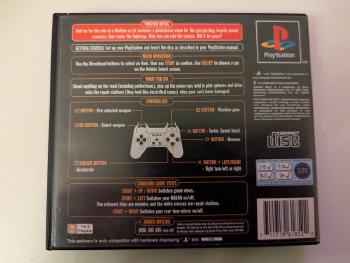
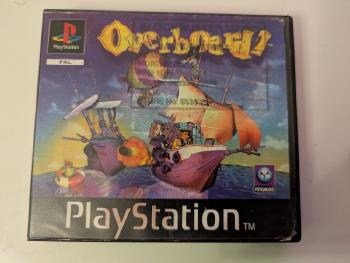
Rentals picked up shop markings too - you can just make out the faded Blockbuster Video stamp across the title on my copy of Overboard!.
Coloured Stripe Discs
The first rentals released were a small band of 15 titles, all published by Sony Computer Entertainment themselves. They cover roughly the first six months of the PS1’s PAL release, from launch on 29 September 1995 through to around March 1996. That’s most of SCE’s titles from that window, but not all of them.
The key feature of these variants is the disc. Each one has a uniquely coloured striped pattern, and the stripes carry a standard warning, in nine European languages, that this is a rental disc and not a retail one.
Twisted Metal is a good example, with its turquoise stripes. The cover is the same artwork as retail.
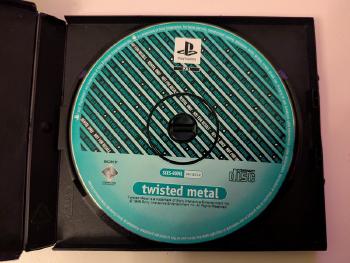
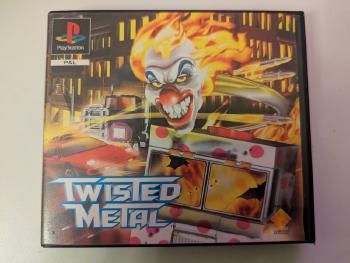
Interestingly, it appears the Danish translation on these is completely wrong. The stripes read “KUN TIL DETAILHANDEL - IKKE TIL VIDERESALG”, and as far as I can tell “detailhandel” means retail - so it’s telling Danish renters the disc is for retail only. The later black discs say “KUN TIL UDLEJNING” (rental only) instead, which suggests someone noticed. I’m reaching out to friends to find out for sure.
Here’s the full set as I currently know it. The number is the SCES serial, which is why it doesn’t line up neatly with release dates - serials were assigned when a title was registered, not when it shipped. A few of these dates are approximate, too.
| SCES | Title | Disc Colour | Released |
|---|---|---|---|
| 00001 | Ridge Racer | Green | 29/09/1995 |
| 00002 | Battle Arena Toshinden | Blue | 29/09/1995 |
| 00003 | Jumping Flash! | Pink | 01/10/1995 |
| 00004 | Rapid Reload | Yellow | 29/09/1995 |
| 00005 | Tekken | Orange | 01/11/1995 |
| 00006 | CyberSled | Blue | 10/11/1995 |
| 00007 | Air Combat | Pink | 10/10/1995 |
| 00034 | Starblade Alpha | Blue | 15/02/1996 |
| 00035 | Kileak: The Blood | Red | 10/11/1995 |
| 00060 | Mortal Kombat 3 | Pink | 15/11/1995 |
| 00061 | Twisted Metal | Turquoise | 10/01/1996 |
| 00062 | Warhawk | Yellow | 10/11/1995 |
| 00063 | ESPN Extreme Games | Purple | 15/12/1995 |
| 00067 | Total NBA ‘96 | Pink | 20/03/1996 |
| 00163 | Mickey’s Wild Adventure | Cyan | 01/03/1996 |
Why Only Some Titles?
Every coloured disc is published by SCE and released before April 1996. That seems to be a requirement, but it isn’t enough on its own, because one SCE title from that window came on a black disc instead. Philosoma (March 1996) was released the same day as Mickey’s Wild Adventure, which got cyan stripes. So the cut-off looks fuzzy around March 1996, or my copy could be a later pressing.
Psygnosis titles never got colours, even at launch. Launch-window rentals of Wipeout and 3D Lemmings are both on black discs, and so is Assault Rigs from February 1996, so the coloured scheme looks like an SCE-label-only thing for the launch window.
Black Discs: Mark 1
These appear in launch titles, but generally only on Psygnosis ones, up until March 1996, when seemingly all rental titles are unified onto this disc design.
The cover artwork stays the same as retail. At this point the black label hasn’t appeared yet, so there’s no PlayStation logo along the bottom.
This design matches the basic disc design Sony used for PlayStation titles going forward, mirroring the promo, demo and later Platinum discs, where the title sits within a thin rounded capsule shape. The rental warning moves into a block of text at the top of the disc - on my Lifeforce Tenka it’s in eleven languages, adding Greek and Portuguese to the nine on the striped discs.
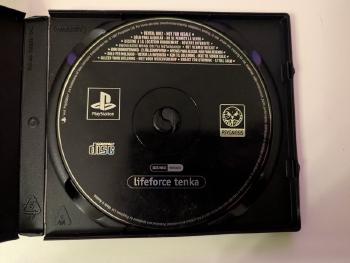
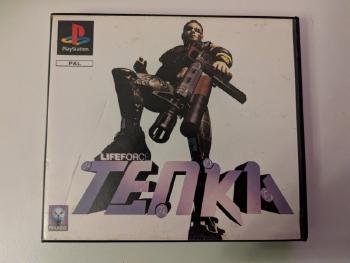
Every Mk1 disc I know of comes from the Sony family: SCE, or Psygnosis, which Sony had owned since 1993. Discworld fits too - Perfect 10 developed it, but Psygnosis published it in Europe. So the real requirement for Mk1 appears to be Sony or Psygnosis publishing, not SCE specifically.
The Psygnosis serials are a mix, though. Launch titles like 3D Lemmings (SCES-00009) and Discworld (SCES-00012) have SCES numbers, but from Assault Rigs (SLES-00093) onwards they’re SLES, like Lifeforce Tenka’s SLES-00613.
Mk1 runs from launch through to at least the middle of 1997 - Lifeforce Tenka came out in July 1997 and is still on a Mk1 disc.
Rental, Promo or Demo?
Funnily enough, as a collector it’s easy to mistake the various black discs from this period at a glance.
- Rental - the localised legal text (rental only, not for resale) in multiple languages is at the top of the disc, white on black, and the title is below the spindle hole
- Promo - the multi-language legal text is at the bottom and the title is above the hole. These are easier to spot, because the text is black on the silver data layer rather than white on black
- Demo - the closest lookalike. These keep the black background with white text, but use the promo layout, with the text at the bottom of the disc
Black Discs: Mark 2
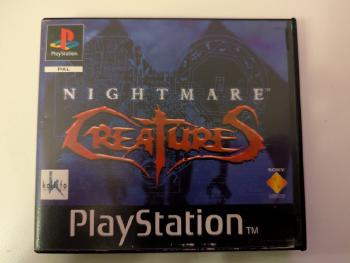
There appears to be a similar timeline between the introduction of the black label retail releases and the second version of the black rental disc. For Psygnosis at least, the switch happened between July 1997 (Lifeforce Tenka, still Mk1) and October 1997 (G-Police, Monster Trucks and Overboard!, all Mk2). The covers change too - my Mk2 rentals have the black PlayStation band along the bottom, just like retail.
The biggest change is at the top of the disc. The block of languages is gone, replaced by a large English-only “RENTAL ONLY / NOT FOR RESALE”.
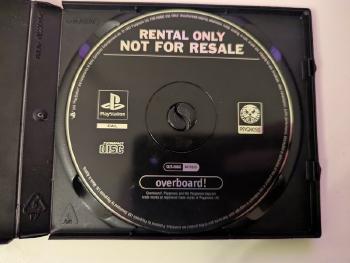
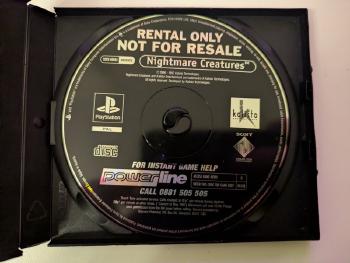
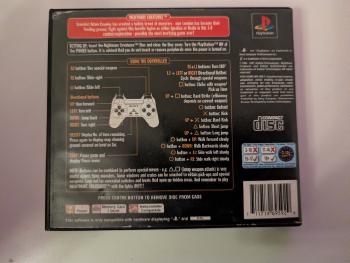
On the two Mk2 discs I have here, SCE and Psygnosis go their separate ways. Psygnosis’s Overboard! keeps the title below the spindle hole and leaves the bottom of the disc fairly empty. SCE’s Nightmare Creatures moves the title above the hole, because there’s a certain level of enshittification going on - a large portion of the real estate has been taken up by an advert for the Powerline, a premium-rate game help telephone line.
The Powerline
The Powerline was Sony’s premium-rate PlayStation hint and cheat line, separate from the hardware support number. It wasn’t new - rental back covers had been advertising it as the Games Hotline, on the same 0881 505 505 number, since launch. Unlike Nintendo’s Power Line, which had live staff, this was a touch-tone service, so it looks to have been a menu of pre-recorded tips for specific games.
The small print changes over time, which makes it handy for rough dating:
| Wording dated | Seen on | Price per minute | Run by |
|---|---|---|---|
| November 1995 | Twisted Metal back | 25p cheap rate, 39p other times | Adcall, London |
| January 1997 | Lifeforce Tenka back | 28p other times, 41p daytime | Adcall, London |
| May 1997 | Overboard! back, Nightmare Creatures disc | 28p other times, 41p daytime | Telecom Potential, Clevedon |
Every version caps a call at £2.99.
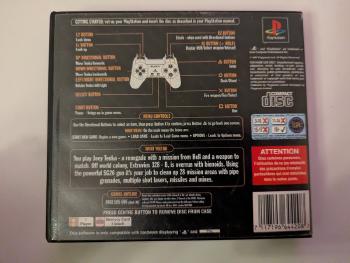
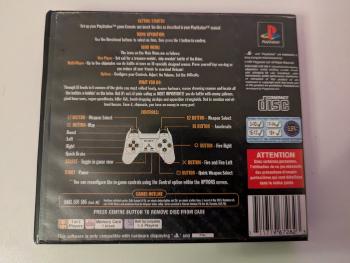
One thing to be careful of: the “correct at” date is when the wording was written, not when the disc was pressed. Wild Arms came out in October 1998 but still carries the January 1997 text, so it only tells you the earliest a disc could have been printed.
By December 1998 the UK number had moved to 09064 765 765 at 60p a minute - another jump in price - as UK premium-rate lines moved over to 09 numbers.
Other countries had their own lines, such as 1550 13 14 15 in Ireland and 0190 578 578 in Germany, and Sony seems to have used local operators in each. Telecom Potential, who took over the UK line, was an outsourced call-handling company based at Clevedon Hall. A consortium led by the company bought the hall after the girls’ school there closed in 1991, and it grew to become Clevedon’s largest employer before it was acquired in 2000.
Game Codes
The Powerline discs also print a code that takes you straight to the game’s help. On Wild Arms it’s 00321, which matches its SCES serial. On Nightmare Creatures it’s 00528 - the serial SCES-00582 with two digits swapped. Whether that’s a typo on the disc or the codes aren’t simply the serial, I don’t know yet.
SCE Only
The Powerline only made it onto SCE discs. None of the Psygnosis Mk2 discs I know of carry it - G-Police, Monster Trucks and Overboard! - while all four SCE Mk2 discs do: Porsche Challenge, Nightmare Creatures, Wild Arms and R-Type Delta.
Psygnosis rentals still advertise the same hotline on the back cover - it just never made it onto their discs. SCE went the other way: my Nightmare Creatures back cover has no hotline box at all, because it’s on the disc instead.
Later on it appears the Powerline was dropped altogether, because later SCE rentals don’t carry the text. I haven’t pinned down when that happened yet.
Quick Reference
| Disc | Publisher | When | Rental Text | Powerline on Disc |
|---|---|---|---|---|
| Coloured stripes | SCE only | Launch to around March 1996 | Nine languages, in the stripes | No |
| Black Mk1 | SCE and Psygnosis | Launch to mid-1997 | Multiple languages, top of disc | No |
| Black Mk2 | SCE | From late 1997 | English only, top of disc | Yes, until it was dropped |
| Black Mk2 | Psygnosis | From late 1997 | English only, top of disc | No |
Still to Work Out
This is very much a work in progress, and I’ll keep investigating to get to the bottom of the Mk2 changes. The big open questions are:
- When exactly did SCE switch to Mk2? Psygnosis switched between July and October 1997, but SCE may not have moved at the same time. Any 1997 Sony rentals would help narrow it down.
- When was the Powerline dropped? The first SCE Mk2 disc without it would date the end of the service.
- Did any Psygnosis disc ever carry the Powerline? One counter-example would break the rule.
- Are the Powerline codes just the serial? Wild Arms says yes, Nightmare Creatures says not quite.
- What about third-party publishers? I haven’t confirmed a single rental disc in these styles from Gremlin, Codemasters, Eidos or the rest. They may have used a different disc altogether, or never had Sony rental discs at all.
If the pattern holds, rentals of Destruction Derby, Novastorm, Chronicles of the Sword and Namco Museum Vol. 1 should all be on Mk1 discs.
If you have rental copies - especially 1997 Sony titles or anything from a third-party publisher - I’d love to see photos of the discs.