Earlier this month I posted an article on the rental variants you can find on PSX. I find them fascinating, especially the launch ones with the coloured discs. I uploaded a handful of rentals so the article had live examples to point at, but a handful felt thin. I own quite a few, so I added the rest of my collection with photos. That still wasn’t enough: most of the rentals I knew existed were missing from the database, so I went through my own research notes and added every one I had documented.
It showed me something I hadn’t noticed. Rentals are overwhelmingly Sony games, either SCEE-published or from second parties like Psygnosis, and that holds across the whole life of the PS1. I wasn’t shocked, because the coloured launch discs were all SCEE too (the other launch rentals, like WipEout and Discworld, got a plain black fallback design). What surprised me was that the pattern never really breaks. Almost every rental in the library is a Sony game.
Epidemic stands out
While crunching those numbers, my old friend Epidemic turned up again. It was a hologram release, so its rental disc uses the newer black Mk2 design. Every other SCEE rental from that era carries an advert for contacting Powerline on the disc. Epidemic has none, and looks oddly blank next to its Sony siblings.
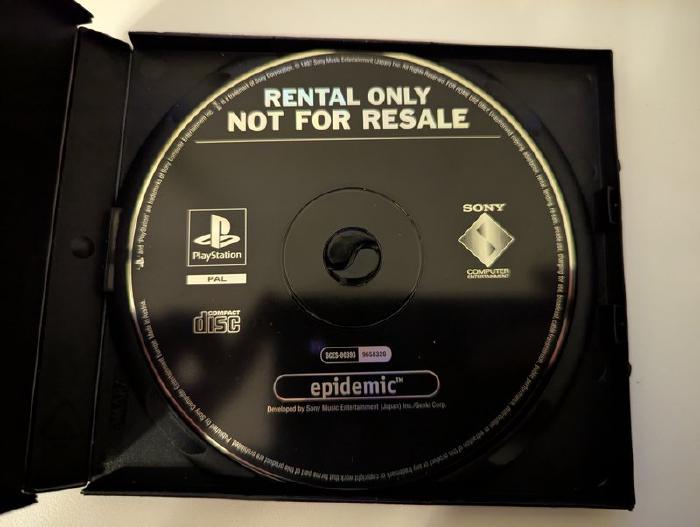
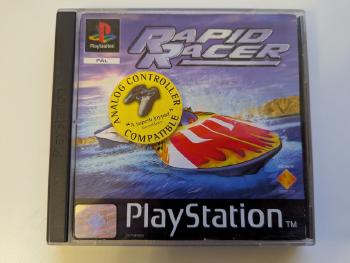
So I started breaking down the timing, comparing it with the Namco Museum 3 rental, Penny Racers and Rapid Racer, and the questions piled up.
Most sources say Epidemic came out in summer 1996. Its siblings’ serials all date a year later, and there were plenty of hologramless releases throughout 1996 before the new design took hold. Kileak, its predecessor, came out in November 1995, and seven months seemed awfully short. PSXDatacenter gives the US edition the identical date, so it looks like the US date was copied over at some point and has propagated around the internet for a couple of decades.
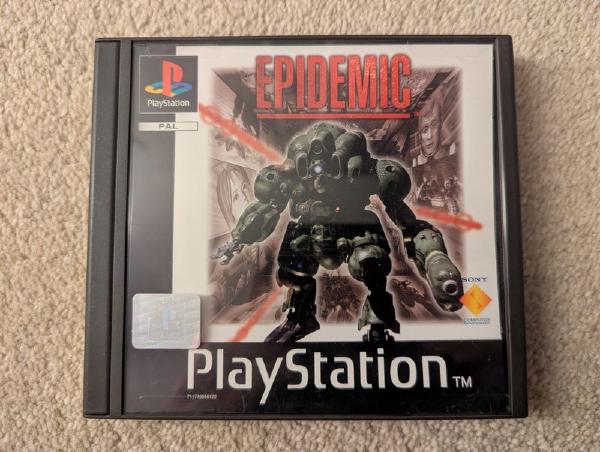
The nail in the coffin was the copyright year, 1997, printed on the back of the case and on the disc itself. That puts a hard early line on when it could have reached shelves.
Finding the real date
Some sites claim March 1997, which may be an early Sony Europe schedule date that slipped. Consoles+ 64 in France (April 1997) reviews it and lists “Disponibilité: avril”, but it never arrived then. In the UK, the June 1997 issue of Official PlayStation Magazine says it is coming in June, and GamesMaster 58 (August 1997) says “Out Now”. Cover dates and what a magazine says need separating. UK monthlies went on sale about three weeks before their cover month, so a cover date tells you when the text was written, not when the game came out. What the text says is the evidence. OPSM’s June cover date means it was on sale in mid-May, and it says Epidemic is “coming in June”, so I take that as June. GamesMaster 58 has an August cover date, so it was on the shelves in mid-July, and “Out Now” has to be read as out by mid-July at the latest. Together they point to June 1997.
I settled on June 1997. We don’t have a day, only a month. This research is what prompted me to drop exact dates where I only know the month, and the database now supports month and year granularity as well as full dates.
There is one more clue. Epidemic’s serial, SCES-00393, sits right next to NHL Face Off ‘97 (SCES-00392), which came out in March 1997. The two were registered together, but Epidemic shipped about three months later. That fits a game designed for the March hologram rollout that then slipped, and it would explain why a June release carries a case printed to the rollout design. That is a story for the Epidemic case post, which I will need to soften, since Epidemic was never the first.
When did holograms actually start?
With Epidemic in June 1997, the game I thought was the first hologram was now several releases into the rollout. So when did it really begin?
I worked through every game with a hologram in early 1997 and started ticking off the ones wrongly listed as 1996 releases. A few examples:
- Devil’s Deception: listed November 1996, actually late 1997 (OPSM November 1997, “Out Now”).
- Air Race: listed January 1997, actually December 1997 (reviewed in OPSM 26).
- Road Rage: listed January 1997, actually June 1997 (magazine for-sale listings).
- Mega Man 8: listed February 1997, actually October 1997 (the US date had been copied over).
- Ayrton Senna Kart Duel 2: listed January 1997, actually January 1998 (Japan was November 1997).
Clearly the March 1997 release of six Platinum titles marked the start of the rollout. A February release of Namco Museum Vol. 3 appears to be the first game released with a hologram, though it has no black label and CVG reviewed it in January 1997, so it may turn out to be earlier.
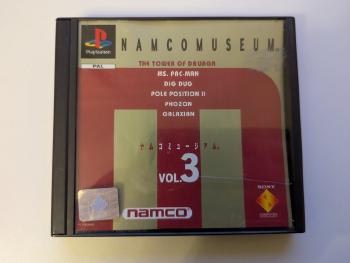
It makes sense that the first games would be Sony’s, since Sony was mandating holograms across releases going forward. As the picture built up, Epidemic turned out to be nowhere near early. It is perhaps the twentieth hologram release or later.
Four habits that produce bad dates
Almost every wrong date came from one of four habits in online databases:
- The US date copied into the PAL entry. Mega Man 8, Master of Monsters, Kensei, the French Jonah Lomu Rugby, and Epidemic itself.
- The wrong year. Senna Kart Duel 2 and Air Race.
- Placeholder days. A 1st or 15th of the month, or 31 December, usually means only the month or year was known.
- Mastering dates shown as release dates. King’s Field was mastered on 13 December 1996 and shipped in March 1997.
Hologram A to hologram B
I’d now spent a week sorting this out, and I realised holograms were being published from early 1997, yet hologram B, the second design, seemed to arrive only six months later. Did Sony really redesign the hologram that quickly? And why?
So I started digging. For each game I had a hologram B for, there was a whole lot of eBay listings showing hologram A. I rely mostly on sealed and graded copies to confirm which hologram a game has, because it’s all too easy to swap a case, and these games have had to survive for approaching 30 years. Sometimes you can tell it’s the original case because an HMV sticker is still on the front, but when most listings for a game show A, my records of a few sealed B copies start to look shaky.
Why sealed copies mislead
Relying on sealed copies has a built-in bias. Almost nobody in 1997 bought a brand new Rapid Racer and left it in the shrinkwrap, so nearly every sealed copy today is unsold retail stock that surfaced years later. That favours late print runs and games that sold badly. A hologram A release that sold well was reprinted, often as Platinum, so the stock that survives sealed leans towards whichever hologram was in use at the end of a game’s life. A missing sealed A doesn’t mean there was no A.
The Crash 3 breakthrough
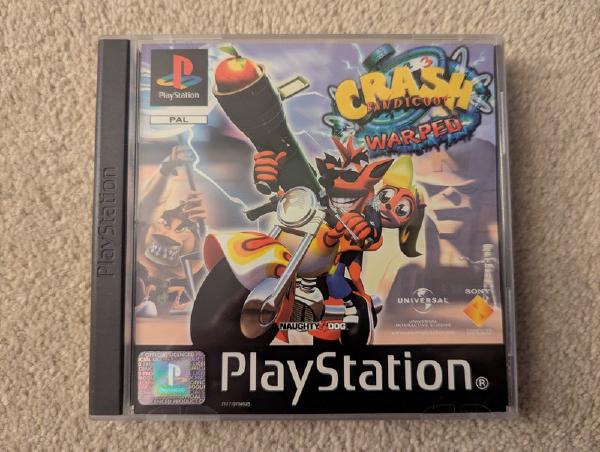
A couple of months ago someone pointed out that Crash Bandicoot 3 came out with both A and B, something I had long suspected but hadn’t spent time proving. They showed me two eBay listings for sealed copies, each with a different hologram. The A copy is the Euro release with a demo disc; the B copy is the UK release without one. That gave me a minimum lifetime for hologram A, and a reasonable assumption: a game as successful as Crash 3 would have had numerous print runs. It was released at the end of 1998 with A still being applied, and at some point Sony switched and later prints carried B.
Working it back, then forward
So I worked from the first hologram B I had in 1997 through to almost everything released in 1998, and I kept seeing the date for hologram B pushed back, because I knew Crash 3 launched with A.
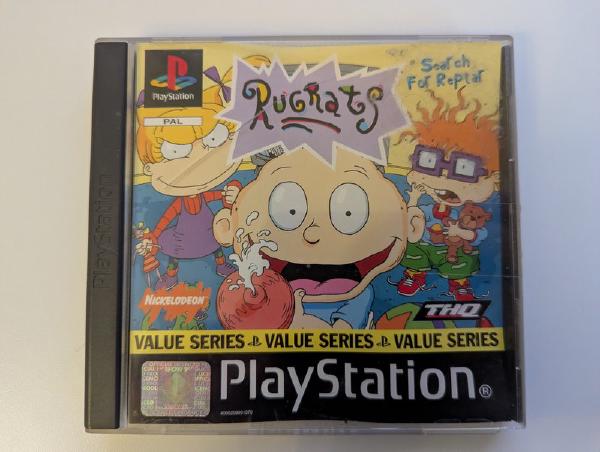
Other pairs turned up as I went. Ninja: Shadow of Darkness exists sealed in both A and B in German, and Devil Dice has four sealed copies, all A. Reprint logic helped too. A changed or shared EAN separates a launch print from a reprint, and that resolved Monopoly, Hercules and Rugrats Search for Reptar. In Reptar’s case the UK launch (serial 01538, 16 November 1998) is hologram A, and a copy on a different barcode, otherwise identical, carries B and looks like a later reprint.
I also had to throw out holograms I couldn’t prove. When the dust settled, the database held 110 hologram B variants dated before 1999, across 41 titles (26 in 1997, 80 in 1998). It now holds none. Most were retyped as A, untyped or no hologram, or re-dated into 1999 or later. The sheet now shows what is documented rather than what was assumed.
The first dated hologram B originals I can pin are Cool Boarders 4 (10 January 1999) and Ape Escape (7 February 1999). In the data, the A/B crossover lands in the first quarter of 1999 (27 A against 57 B), and A is nearly gone by the third quarter. Hologram A therefore ran from March 1997 into early 1999, about two years, not the under-a-year I thought when I started. I can’t find a single documented B before 1999, and I haven’t yet continued the hunt through 1999 itself to see how much further the date can move. That’s another mission.
Rugrats: a localisation spread over years
Rugrats Search for Reptar shows how messy “the Europe release” can be. The UK edition is November 1998. French, German, Italian, Dutch and Spanish versions are dated 1999, and later pressings and Value Series copies run through 2000 and 2001. The copyright years on the discs and cases are what first made me realise that this game’s localisation was pulled across several years rather than released once across Europe, which is a rare occurrence. It is also why a single “release date” for a game like this is misleading.
What’s still unknown
- A sealed anchor for hologram B. Cool Boarders 4 and Ape Escape have dates but no sealed copy confirming them.
- First-hand dates for the March 1997 anchors: Samurai Shodown III, Total NBA ‘97, the UK King’s Field and Namco Museum Vol. 3.
- What the earlier transition examples really are. My hologram history used Ridge Racer Revolution and the French Dragon Ball Z as examples of games that gained a hologram partway through the 1997 rollout. We realised they can’t be transition variants, because the hologram on them is a B. That makes them much later reprints, and the data now dates those copies to 1999. It is also a reminder of how long a game could stay in print: Final Fantasy VIII was still being reprinted as a Platinum in 2006, which is how it ended up with PSP holograms on its PS1 case. I still need to work out exactly when those reprints happened, and rewrite the transition paragraph before reusing it.
Corrections to earlier posts
This research contradicts a few things I’ve written before:
- A Brief History of the PS1 Case Hologram says Epidemic was the first to feature the black label strip, dates the hologram’s introduction to early Q2 1997, and puts hologram B in late 1998. The data now says March 1997 and early 1999, and its usage graph needs regenerating.
- Epidemic: My Favourite PS1 Case Disaster: the physical evidence (centred logo, misplaced hologram, scaled artwork) stands, but the “first” framing doesn’t.
A rabbit hole of quirks
Even as I recall this quest, I can barely remember why I started it. The PS1 is an absolute rabbit hole of quirks and oddball releases. This week I stumbled on a copy of Warhawk in a standard CD case, something I’d seen for Actual Soccer and Mortal Kombat 3. But Warhawk? I’ve been looking at those for years trying to find a good rental copy, and I’d never spotted this one. Wonderful stuff.
And then the next day I saw what looks like a copy of GTA 1 in a Maxibox. I’ve yet to verify it, but it’s something I’ll have to look out for now.
Help me fill the gaps
Everything above came from comparing photos, magazines and sealed copies, and it only gets better with more of them. If you have a hologram A or B you can date, a sealed copy, an old magazine scan, or a rental, Maxibox or standard-case oddity that is not in the database yet, I would love to see it. You can submit your photos and data, or just get in touch if you have spotted something interesting. If I have a date wrong, tell me.