A week and a half before Games Day in Dundee, I spent a day at the National Museum of Scotland in Edinburgh for Playable Heritage: Creating a Collaborative Framework for Collecting Video Game Culture. It was put on by National Museums Scotland and the National Library of Scotland, and the room was a real mix - museum curators, archivists, academics, lawyers and industry veterans. It was also where I first came across the term GLAM - short for Galleries, Libraries, Archives and Museums - which the heritage sector uses for the institutions that collect and look after our culture. It was completely new to me, but it came up all day. Having spent 20 years working in the games industry myself, and running this site on the side, it was one of those rare events that crossed over just about every one of my interests.
The question running through the whole day was a simple one: how do we collect, preserve and share video game history before it disappears? It’s a question that sits right at the heart of what this site is trying to do, so I was always going to be there. But the session I’d really circled on the schedule was the keynote from Charles Cecil of Revolution Software.
Revolution and me
A bit of personal history first. I fell in love with Revolution through Beneath a Steel Sky on the PC - that mix of dark humour, a grimy future city and Dave Gibbons’ art was unlike anything else I’d seen or played. It was mesmerising to see on the older hardware in the early 90’s. I followed the studio from there to Broken Sword, and later to In Cold Blood on the PlayStation, which I still think is underrated. So getting to hear Charles talk, and then meet him afterwards, was a big deal for me.
I brought my PAL copy along, and he was kind enough to sign it.
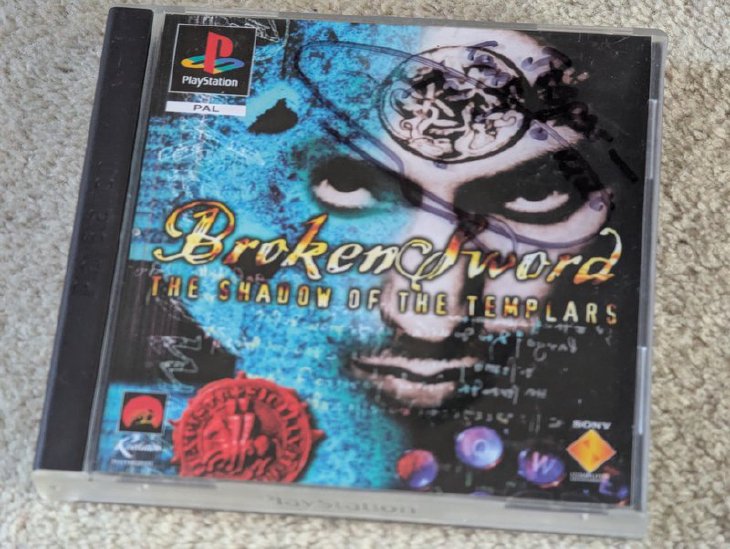 My UK original release of Broken Sword, now signed by Charles Cecil
Cash in the attic
Charles’s keynote opened a session called “Cash in the attic: how your back catalogue can power your studio’s future”. As with the Games Day post, what follows is my paraphrase from my notes rather than exact quotes.
He didn’t hold back. His target was the way the industry worked in the 1990s and early 2000s, when publishers and retailers held the keys. A developer needed a publisher to fund the game, and a publisher needed retailers to stock it, and the studio that actually made the thing came last in line for the money. Charles described it as a system that strangled his company.
The example that stuck with me was Broken Sword 3. By his account, the game made THQ around £5 million, while Revolution lost roughly £250,000 making it. A successful game, and the studio behind it came out poorer. The model was broken, and Revolution was mothballed not long afterwards.
He kept everything
The twist is what happened next. Through all of that, Charles kept everything - the original drawings, the sketches, the background art, the lot. Nobody at the time thought of it as an asset. It was just stuff in the attic and he thought “it was a good idea” to keep this stuff.
Then the iPhone arrived, and Apple approached Revolution about bringing Broken Sword to it. The screen resolution of those early iPhones was close to a 1990s PC monitor and PlayStation, so the original game could be ported pretty much directly. The back catalogue suddenly had value again, and it was the studio - not a publisher - that owned it.
And when Revolution came to remaster the game in 2024 as Shadow of the Templars: Reforged, that archive paid off a second time. Because they still had the original hand-drawn artwork, they could rebuild the game at 4K from the real source material rather than upscaling low-resolution images.
That was really the point of the talk, and it fitted the day perfectly: keeping your history isn’t just nostalgia, it can be what keeps a studio alive.
How Broken Sword came to PlayStation
This is the bit I was most excited about, and it came from chatting to Charles afterwards rather than from the talk itself.
His first choice of publisher for the PlayStation version was Virgin, who had published the PC game - but they weren’t interested in publishing to the PlayStation. So he went directly to Sony, and struck a deal with them instead. Part of that deal saw Broken Sword featured on the cover of the Official PlayStation Magazine in three regions, putting the game in front of around 1.6 million players. It was a great success.
That lines up nicely with what we have in the database. Broken Sword came out on PAL PlayStation in December 1996 under Sony’s SCES prefix, and rather than one multi-language pressing it got separate national editions for the UK, France, Germany, Spain and Italy. The UK copy even carries a round yellow “9/10 - Official PlayStation Magazine” sticker on the case - a small physical trace of that exact relationship. Broken Sword II followed in November 1997, also through Sony, again with five national editions.
You can see all the variants on the Broken Sword, Broken Sword II and In Cold Blood pages. If you’ve got one we’re missing, or better photos of one we have, please send it in.
The rest of the day
Every session was worth sitting through, but a few stood out.
Mike Dailly - of Lemmings and GTA fame, and who I’d see again at Games Day - closed the day with a talk called “Oh No! We Left it Too Late”. It was brilliant to see just how much of a geek Mike is about old hardware, and his collection of everything Lemmings is intense. For PS1 collectors, Lemmings turned up as Lemmings & Oh No! More Lemmings, 3D Lemmings and strangely as a platformer in Lomax.
I also really enjoyed Glaire Anderson from the University of Edinburgh, whose talk “Game as Museum: Authenticity, community, and curating playable pasts” looked at games themselves as places that hold and present the past. That idea rings true for a lot of us in the retro community - a shelf of PAL jewel cases is its own kind of small museum.
Elsewhere, there were sessions on:
- Collecting in practice - how National Museums Scotland, the Science Museum Group, the V&A and the National Videogame Museum are approaching games in their collections
- Industry archiving - Rebellion talking about how they archive their own games in-house
- Preservation and the law - a panel from CREATe and others on copyright, and why it’s so hard for institutions to legally preserve and share games
- Oral history and cover disks - capturing developers’ memories, and emulating Amiga magazine cover disks
That last one stuck with me. Magazine cover disks and demo discs are exactly the kind of thing that falls through the cracks - not quite a game, not quite a magazine - and PS1 had plenty of its own.
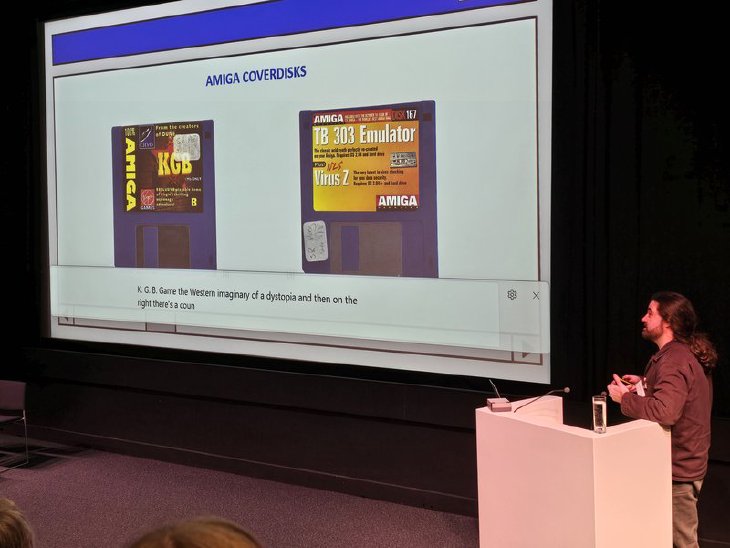 The cover disks talk at Playable Heritage - Amiga magazine cover disks on the big screen at the National Museum of Scotland
Why this matters for us
What I loved most about the day was the energy in the room, and the shared recognition that there’s a huge amount of work still to do. A lot of video game history is being lost right now - the documents, the art, the memories, and yes, the physical releases and all their little differences.
The big institutions are starting to take this seriously, which is great to see. But nobody is going to catalogue every PAL PlayStation reprint, sticker and manual variation for us. That’s our little corner of it, and I hope this site can cover it in a way no one else is.
Thanks to National Museums Scotland and the National Library of Scotland for putting it on, and to Charles for his time, his stories and his signature.