Earlier this year we went on holiday to Crete, and while we were in Heraklion I couldn’t resist a detour to the Video Games Museum, which was right in the middle of the old town when we visited.
It’s a fairly new space - it opened in January 2025 - run as a non-profit and explicitly focused on preserving video game history. It’s the first Greek member of EFGAMP, the European Federation of Game Archives, Museums and Preservation Projects, which is the clearest signal you’ll get that this is a serious preservation operation.
The permanent exhibition runs through 300+ consoles arranged roughly chronologically, from the Magnavox Odyssey onwards. There’s a great selection of portable consoles and some old single-game handhelds from the 80s and 90s - some I even remember playing as a kid. It was fascinating to see a Color TV-Game Block Kuzushi in the flesh as well, one of the dedicated consoles Nintendo made years before the Famicom.
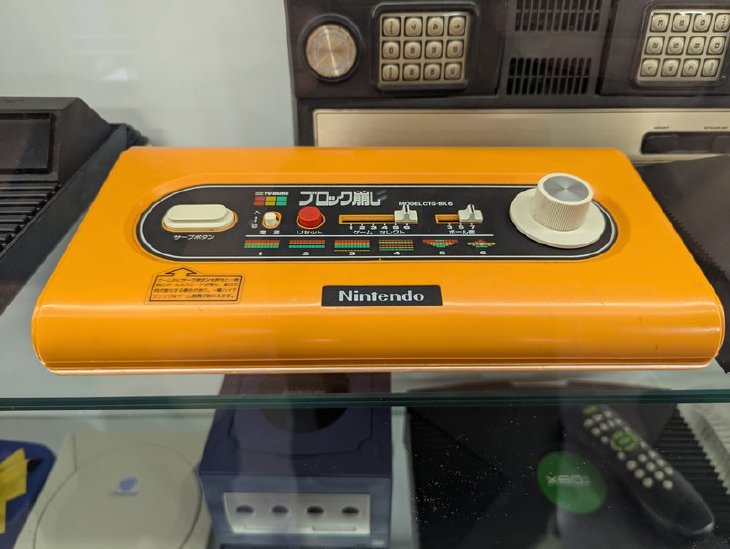 Nintendo’s Color TV-Game Block Kuzushi (1979) - a Breakout-style console that only came out in Japan
Plenty of that will be familiar to anyone who’s been to a retro gaming exhibit before. What I found most memorable, though, were the small thematic tableaux scattered around the space - carefully dressed recreations of a 1980s living room and a 1990s kid’s bedroom, complete with period furniture, posters, magazines, and a working setup of the era. They were genuinely evocative in a way that a glass case never quite manages.
The highlight for me was the PlayStation bedroom - a recreation of the museum owner’s own PS1 setup, and it was wonderful to see. The owner is the same age as me, so we shared a very similar memory here: a pine desk, a little CRT, a grey PlayStation and walls covered in film posters. It’s interactive too, so you’re encouraged to pull up the chair and play like you may have 30 years ago. It also gave me a chance to bother Jeeves in Tomb Raider II again!
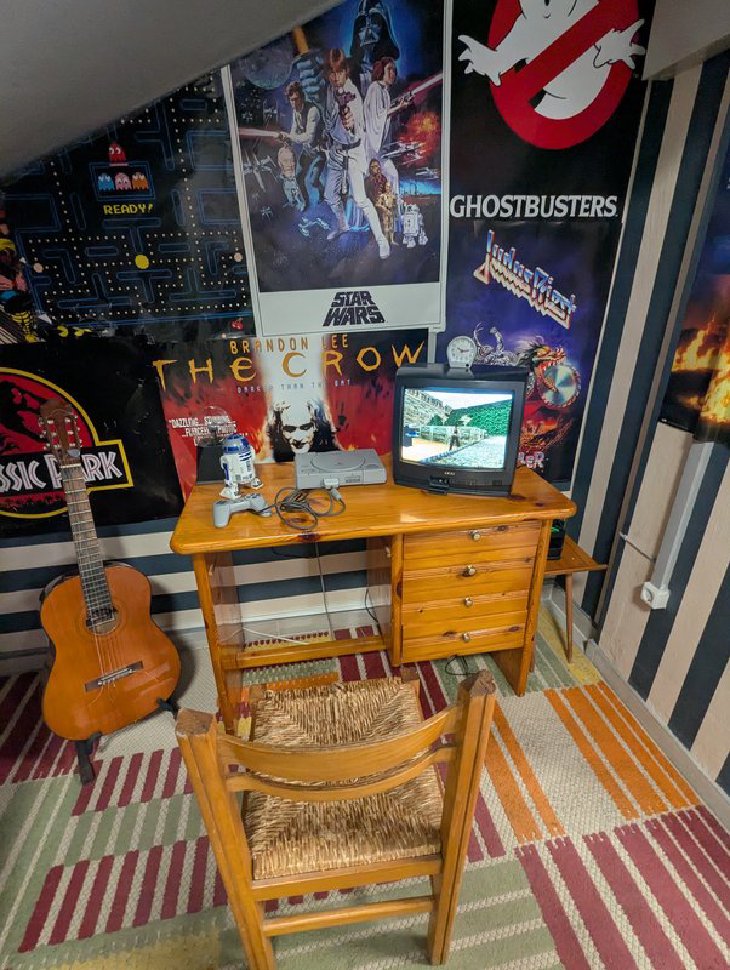 The museum owner’s PlayStation setup, recreated - Tomb Raider II on a little Akai CRT
When Greece Banned Video Games
It was fascinating to speak to Nikos at the museum, who filled us in on the more recent history of video games in Greece - including something I’d never heard of. For nine years, playing video games in public was against the law.
In July 2002 the Greek parliament passed Law 3037/2002. It was aimed at illegal gambling: a politician had been caught on video in an illegal gambling den, and in the scandal that followed the government decided it couldn’t reliably tell an innocent arcade game from a disguised slot machine. So it banned electronic games in public places altogether, with fines of 5,000 to 75,000 euros and up to a year in prison.
The wording was so broad that, on paper, it covered PCs, consoles, mobile phones and handhelds - and it applied to tourists as well as Greeks. You could, in theory, be fined for playing a Game Boy in a park, which is how the story made headlines abroad as “In Greece, use a Game Boy, go to jail”.
Internet cafés took the brunt of it. They could stay open as long as nobody played games on their computers, so if a customer started a game it was the owner who was in trouble. In 2002 two café owners and an employee were prosecuted in Thessaloniki after police found customers playing online chess and Counter-Strike - no gambling at all. More than 300 people turned up outside the court to support them, and the judge threw the cases out, ruling the law unconstitutional.
That didn’t end it. In January 2004 police raided internet cafés in Larissa, seizing 80 computers and arresting three owners. The European Commission took Greece to the European Court of Justice, which ruled against Greece in 2006 - but the law wasn’t finally repealed until 2011.
Some of the museum’s own arcade machines still carry clues to what the law was really aimed at. Nikos pointed out hidden buttons under the main control panel that could switch over the internal boards, turning an ordinary-looking arcade cabinet into an illegal slot machine - really fascinating!
If you’re ever in Heraklion it’s well worth an hour or two - and if you grew up with a PS1 and CRT like me, the PlayStation bedroom alone is worth the visit!