Yesterday I headed over to Games Day 2026, the Scottish Games Developers Association’s annual get-together at Water’s Edge in Dundee. It’s mostly an industry event - talks, demos, panels and a lot of networking, finished off with a ceilidh - but there was one session on the schedule I wasn’t going to miss: GTA Origins.
Dundee is where it all started. Grand Theft Auto was made by DMA Design in the city, and five of the people who built it were on stage together - Dave Jones, Colin Anderson, Mike Dailly, Keith Hamilton and Patrick Kerr - with Gary Penn chairing. Patrick wasn’t on the programme, so he was a nice surprise. Someone had scribbled “Junior Developer” on his name badge as a joke, because he was a very young developer at DMA when GTA was made - he’s a good deal more senior these days.
I brought my PAL PlayStation copy along in the hope of getting it signed, and I got lucky.
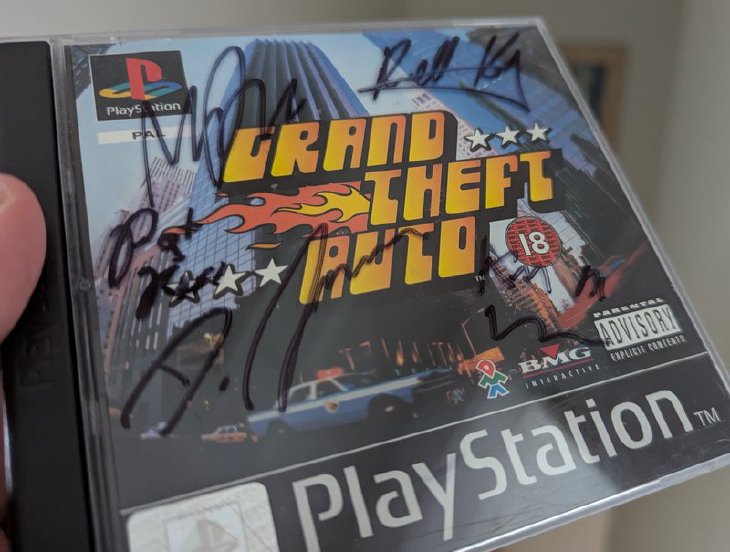 My original release of Grand Theft Auto, now signed by the team
It’s an original release copy, and it’s now signed by:
- Dave Jones - “Capo Di Tutti Capi”
- Mike Dailly - graphics engine and initial concept
- Keith Hamilton - lead programmer
- Patrick Kerr - car physics
- Russell Kay - the PS1 release
Getting Dave’s signature was really mint as he doesn’t attend many events these days. Russell Kay’s signature is particularly special for this site. Getting the signature of one of the people responsible for bringing GTA to the PlayStation, on a PAL PlayStation copy, felt like a great way to round it off.
The GTA Origins panel
I scribbled notes as fast as I could, so what follows is my paraphrase of what the panel said rather than exact quotes (unless I actually use quote marks!).
The overwhelming theme was just how chaotic GTA’s development was. By the team’s own account it wasn’t much fun to work on for most of that time. A game built on emergent gameplay throws up a lot of very difficult bugs, and much of the credit for the game working as well as it did went to Keith Hamilton. The rest of the team kept coming back to how hard he worked, both on stage and when I chatted to them afterwards.
It nearly didn’t happen
GTA also came close to never being released at all. It was published by BMG Interactive, and the two sides of BMG saw it very differently. The UK side got it and backed it, unequivocally. The American side didn’t like it at all, and at one point the game came very close to being cancelled.
Dave Jones also told a great story involving Nintendo. The game was put in front of Nintendo and rejected - even though it was never a “Nintendo” game in the first place. Miyamoto later suggested that perhaps they shouldn’t have passed on it. Hard to imagine GTA on the N64 in 1997, but it’s a fun “what if”. Colin Anderson expressed his relief when publishing to Nintendo was canned. The N64 was the only format still using cartridges (PS1, Saturn and PC CD all used CDs), and their small storage would have killed their approach to music, at least for the N64…
The radio was born out of a budget problem
And speaking of music… The publisher BMG was a music company, and the hope was that the game could draw on BMG’s vast music library. That didn’t work out! GTA’s entire budget was around £1M, and BMG said there wasn’t enough money to license any tracks - “This was before Napster and MP3s, music was incredibly expensive back then” - so the team were forced to write their own music.
They didn’t know the style of music that would suit GTA. Rock was quite traditional at the time for games like this. But electronic dance music was making strides into games at the time. Or should it be more Pop? The audio team were tasked with creating a load of sample music, 30 second pieces, to try out different styles when playing. While listening to demos of the music style they’d come up with, the idea of in-car radio stations clicked with Colin Anderson, and they ran with it. It’s become one of the defining features of the whole series, and it started life as a workaround. They even recruited buskers off the street to record songs. When they decided on radio stations, and the sound becoming more diegetic, things started to fall into place. All sound would come from the world. Different cars would have different radio stations. Steal a cop car - and it’s not a radio station - you’ll hear police dispatch! Colin even spoke about having a list of crimes you can commit, and areas you’re in so they could synthesise the dispatch call as you were committing misdeeds.
Systems on top of systems
GTA was one of the earliest properly open-world games, and the panel were candid about what that cost. The game is built from interlocking systems - cars, pedestrians, police, missions - all reacting to each other, and that was a nightmare for bugs. A lot of the problems came down to pointer issues and entity lifetimes: one object holding on to another that the game had already thrown away. Chasing those down is where a lot of Keith’s effort went. Police cars and ambulances would be dispatched from the police stations and hospitals when needed - they actually ran some path finding across the maps to spawn them properly - so in some areas they might take longer! And the team mentioned how these systems led to further scope creep. On having an ambulance turn up - “can I steal that” the team would say and it’s another thing that needs to be supported. But once you’re driving around in the ambulance, “can I turn on the siren and lights” is the next request - and the scope keeps going.
GTA does seem like an idea that in some ways wrote itself when put in the hands of the DMA team…
Patrick Kerr did most of the talking about vehicle handling. The original system had just two states: normal driving and skidding. Past a certain point the car would flip from one to the other, and the result was handling that was neither realistic nor fun. He spoke about how he felt the urge to tackle this problem over a weekend with physics simulation instead of a binary system. He showed off a lovely demo where the car was simulated using foundational physics and the results were immediately impressive. Without this, GTA would have been a lot less fun. And he wasn’t even on the project at the time! He was working on another game that never saw the light of day, and was brought on board to GTA later.
The BBC came to Dundee
The BBC’s technology journalist Rory Cellan-Jones also came up. He visited DMA Design in 1996 while the game was still in development, and the piece survives in the BBC Archive - well worth a watch for a look at the studio and the team at the time:
There is a moment in the clip where they’re using a motion capture studio, and for any of you who played the original GTA, you’ll wonder how that even featured in the game. And of course this was not used at all, they reckon the actor in the clip was just placed in the studio at the time to make it look used, but it was never used for anything DMA did.
Additionally, they pointed out that the footage of the game all featured the old two state car physics engine, so it’s worth checking out if you’re up for geeking out about that.
Why this matters for PS1 collectors
For those of us focused on PAL PlayStation, GTA is a big one. It’s a Scottish-made game that launched on PS1 in Europe in December 1997 among much controversy about its violence and message. It stayed in print for years afterwards - which means plenty of variants to track. In the database right now we have:
- The UK and EU Original pressings
- Platinum re-releases
- The Enhanced Edition
- Several later reprints, including Value Series Black Label copies
- The London 1969 expansion, the Double Feature pack and the Limited Collector’s Edition
You can see them all on the Grand Theft Auto game page. If you have a GTA variant that isn’t listed, or better photos of one that is, please send it in.
The rest of the day
I stayed for every talk, and GTA wasn’t the only PS1 connection on the bill. Charles Cecil of Revolution Software - the studio behind Broken Sword and Broken Sword II, both of which did very well on PS1 in Europe - gave a talk on the birth of the UK games industry. Bennie Terry III from Oddworld Inhabitants was due to speak but sadly couldn’t make it - a shame, as Abe’s Oddysee and Abe’s Exoddus are PS1 classics. And Mike Dailly and Dave Jones are, of course, two of the people behind Lemmings, which reached PS1 as Lemmings & Oh No! More Lemmings.
It was a really fun day, and it’s rare to get to hear the people behind a game you’ve owned for decades talk openly about how it was made - bugs, budget problems and all. Thanks to the SGDA for putting it on, and to the GTA team for their time and signatures.