A lot of the data in this database is verified against live eBay listings. When I don’t own a copy of a variant myself, a clear listing photo is often the best evidence I can get for a hologram type, a barcode or a catalogue number.
Over the last week though, I’ve noticed some listings showing holograms that look completely wrong. Not fake in the way the reproduction holograms are fake - just odd, like nothing I’ve seen on a real case.
What’s going on
I got in touch with one of the sellers and the answer was simple: they’d run their photos through an AI tool to remove the background. The tool didn’t stop at the background.
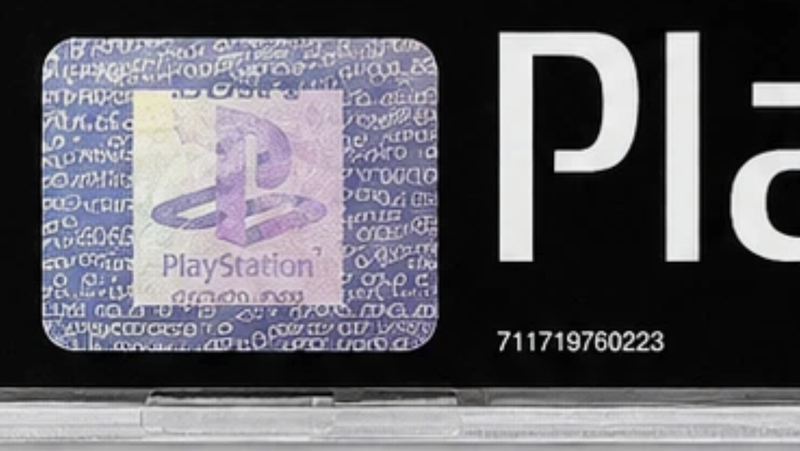
On a genuine hologram, the background is made up of rows of “Official Licensed Product” text. In the AI version, that text is gone and has been replaced with a dense pattern of made-up glyphs that look a bit like writing but don’t say anything. The PlayStation logo has been redrawn too - the colours are off, the SONY text above it is garbled, and so is “Computer Entertainment” beneath it.
For comparison, here is an unedited photo of a genuine hologram:
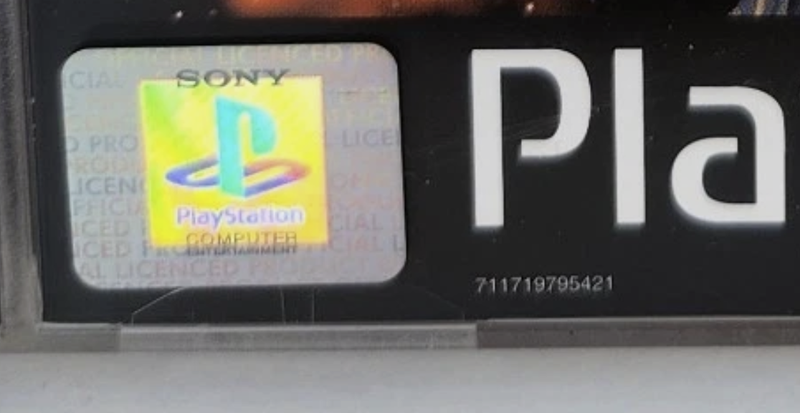
You can clearly read “Official Licensed Product” running through the background, along with SONY and “Computer Entertainment” around the logo.
The barcode problem
The hologram is easy to spot once you know what you’re looking at. What worries me more is the number next to it.
This listing was for Omega Boost, and the EAN printed on this copy should be 0711719795223. The AI-edited photo shows 0711719760223 instead.
That isn’t a different variant - it’s not a valid EAN at all. The last digit of an EAN-13 is a check digit calculated from the other twelve, and for 071171976022 that check digit should be 1, not 3. The model has simply “tidied up” the digits into something that looks plausible.
If I’d taken that number at face value, it would have gone into the database as a new barcode for Omega Boost and possibly been logged as a previously unknown variant. The check digit caught it this time, but an AI could just as easily change a digit and land on a valid-looking code by chance.
Why it matters
To be fair to sellers, eBay listings exist to sell games, not to preserve them. Nobody editing a photo to make their listing look cleaner is thinking about collectors comparing hologram patterns or barcodes.
But listings are a huge part of the raw record for these releases. Many variants have only ever been photographed for a sale, and those photos are often all we have to go on. This is another case of that raw data being quietly rewritten by AI - and unlike a blurry photo, the result looks crisp and confident, which makes it more convincing, not less.
What I’m doing about it
Going forward, I’m treating listing photos with a bit more suspicion:
- Check the hologram first - if the “Official Licensed Product” text isn’t readable, assume the image has been processed.
- Validate every EAN - I have a check for inputted EAN values what flag these.
- Look for a second source - a single edited listing isn’t enough to add a new barcode or variant.
- Ask the seller - most are happy to send an original, unedited photo.
I do worry about the state of our data over the next five to ten years. The more of these images that get processed, reposted and scraped, the harder it will be to tell what’s real. That’s exactly why projects like this one matter - getting accurate records down now, while original copies and honest photos are still out there.
If you’re photographing your own games for submissions, please send the original photos - no filters, no background removal, no “enhancement”.